
Toupee Base Materials Explained: Lace vs. Skin (PU) vs. Monofilament Hair Systems
The base material is one of the most important factors affecting the appearance, comfort, attachment, and maintenance of a men's hair system. Lace, skin (polyurethane), and monofilament are three commonly used base constructions, each offering different characteristics. This guide compares their structures, advantages, limitations, and typical applications, while providing practical inspection and sourcing tips for B2B buyers.
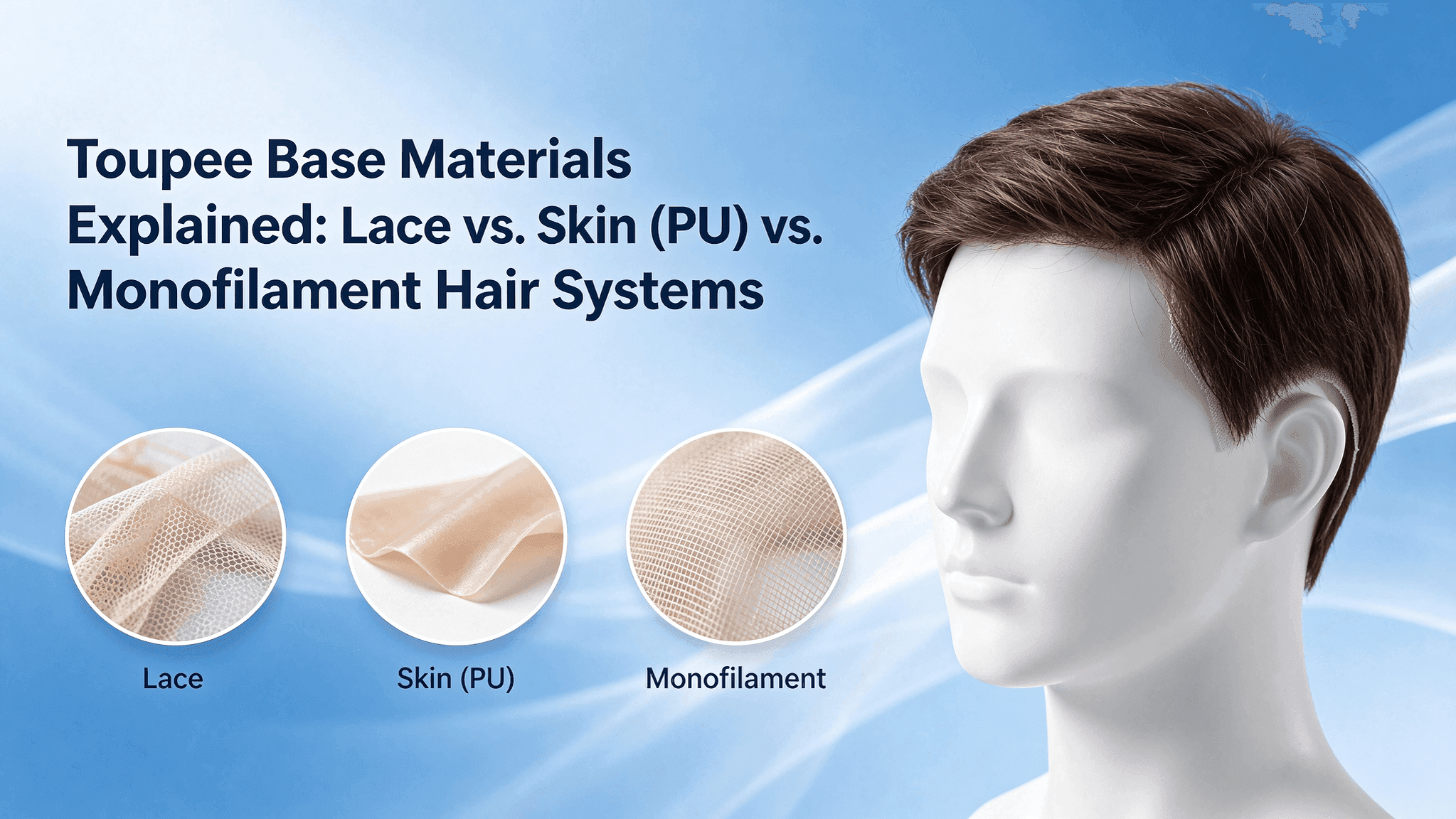
When sourcing men's toupees or hair replacement systems, buyers often focus on hair quality, color, density, and length. However, the base construction is equally important.
The base is the foundation onto which hair is attached. It affects how natural the hairline looks, how the system feels against the scalp, how it is secured, and how much maintenance it may require.
Among the commonly used options, lace, skin (polyurethane), and monofilament bases are frequently considered by manufacturers, distributors, salons, and hair replacement professionals.
Understanding the differences can help wholesalers and importers select products that better match their customers' needs.
1. What Is a Toupee Base?
A toupee base is the material structure that supports the attached hair in a men's hair replacement system.
Depending on the design, individual hairs may be hand-knotted, injected, or attached using other manufacturing techniques. The base may cover the entire system or combine multiple materials in different sections.
Common base constructions include:
Lace base: A fine, open mesh structure into which hair is commonly hand-knotted.
Skin base: A thin polyurethane (PU) layer designed to resemble the appearance of skin.
Monofilament base: A fine synthetic filament mesh that provides a supporting structure for attached hair.
Hybrid base: A combination of materials, such as lace in the central area and PU around the perimeter.
These names describe broad construction categories. Actual mesh structures, thicknesses, knotting techniques, and material specifications vary between manufacturers.
2. Lace Bases: Lightweight and Breathable Construction
Lace bases are made from fine mesh materials. Hair is commonly attached by hand-knotting individual strands or small groups of strands into the mesh.
Because the material contains openings, lace bases allow airflow through the base structure.
Key Characteristics
Lightweight Feel
Fine lace can create a lightweight construction that sits relatively close to the scalp.
Air Permeability
The open mesh structure allows air to pass through, which may be beneficial for wearers who prioritize ventilation.
Natural-Looking Appearance
Fine lace can blend visually with the scalp, especially when the material, color, knotting, and hairline design are well matched.
Flexible Construction
Lace can adapt to the contours of the head, depending on the mesh type and overall base design.
Potential Limitations
Lace can be delicate, particularly when the mesh is very fine. Repeated pulling, rough cleaning, improper adhesive removal, or careless handling may damage the base or loosen knots.
The visibility of knots and the lace edge can also vary with the material color, mesh structure, hair color, and lighting conditions.
Typical Applications
Lace bases may be suitable for customers who prioritize:
Airflow and a lightweight feel.
A relatively natural-looking hairline.
A flexible base structure.
A less solid base appearance.
The actual wearing experience depends on the specific lace construction and the attachment method.
3. Skin Bases: Polyurethane for a Skin-Like Appearance
Skin bases are generally made from polyurethane (PU), a polymer material that can be manufactured in different thicknesses and levels of transparency.
The material forms a relatively continuous surface rather than an open mesh.
Hair may be injected, V-looped, or attached through other techniques, depending on the product design.
Key Characteristics
Skin-Like Surface
A thin, well-matched PU base can create an appearance similar to skin when placed against the scalp.
Adhesive Compatibility
PU surfaces are commonly used with tape or liquid adhesive systems. Some designs feature PU around the perimeter to provide an area for attachment.
Smooth Base Structure
Unlike open mesh constructions, a PU base has a more continuous surface, which can be easier to wipe during routine cleaning, depending on its design and the adhesive used.
Different Thickness Options
Skin bases are available in different thicknesses. Thinner constructions may provide a less noticeable edge, while thicker versions may be selected for different handling or durability requirements.
There is no single thickness that is best for every wearer.
Potential Limitations
A continuous PU surface does not provide the same airflow through the base as an open lace or monofilament mesh.
Very thin skin constructions can be delicate and may be more vulnerable to tearing or damage during removal and cleaning.
The edge may also become visible if the base thickness, color, or attachment method does not match the wearer's scalp.
Typical Applications
Skin bases may be considered by customers who prioritize:
A smooth, skin-like base appearance.
Tape or adhesive attachment options.
A relatively continuous base surface.
Easy surface access for certain cleaning routines.
The suitability of a skin base depends on its thickness, construction, adhesive compatibility, and the wearer's maintenance habits.
4. Monofilament Bases: Mesh Support and Hair Direction
Monofilament, often called mono, refers to a fine mesh material made from synthetic filaments.
Hair is commonly attached to the mesh through knotting techniques. The construction provides a supporting structure that can hold hair while allowing the hair to be arranged in different directions according to the design.
Key Characteristics
Structured Mesh Construction
Mono bases generally provide a defined mesh structure that supports the attached hair.
Hair Direction Options
Depending on the knotting pattern and base design, hair can be arranged in different directions. This can be useful when designing a particular hairstyle or parting area.
Balance of Support and Flexibility
The mesh provides structure while retaining some flexibility. The actual balance depends on the filament, mesh density, and construction.
Different Mesh Designs
Monofilament bases can vary in mesh fineness, strength, color, and knotting configuration. Buyers should not assume that all mono products have the same performance.
Potential Limitations
Mono mesh can be more noticeable than very fine lace in certain lighting or viewing conditions.
Knot visibility, mesh color, and hair density can all influence the final appearance.
Cleaning and maintenance should also follow the manufacturer's recommendations to avoid damaging the mesh or loosening the knots.
Typical Applications
Mono bases may be suitable for customers who prioritize:
A structured mesh construction.
Support for hand-knotted hair.
Specific hair direction or parting designs.
A balance between base support and flexibility.
5. Lace vs. Skin vs. Mono: Key Differences
The three materials are not direct substitutes in every application. Each construction involves different trade-offs.
Comparison | Lace Base | Skin (PU) Base | Monofilament Base |
|---|---|---|---|
Basic structure | Fine open mesh | Continuous PU layer | Fine synthetic filament mesh |
Airflow through base | Generally good | Limited through the solid PU area | Depends on mesh construction |
Surface appearance | Fine mesh | Skin-like surface | Mesh texture may be visible |
Hair attachment | Commonly hand-knotted | Injected, V-looped or other methods | Commonly hand-knotted |
Adhesive use | Depends on design and attachment area | Commonly compatible with tape or liquid adhesive | Depends on design and attachment area |
Flexibility | Depends on lace type | Depends on thickness and formulation | Depends on mesh construction |
Main consideration | Mesh delicacy and knot visibility | Thickness, edge visibility and maintenance | Mesh visibility and knot appearance |
A key point for buyers is that the material name alone does not determine product quality. Two bases described as lace, skin, or mono may perform differently because of differences in raw materials, thickness, mesh structure, knotting, and manufacturing quality.
6. What Is a Hybrid Hair System Base?
Some hair replacement systems combine two or more base materials.
For example:
Lace in the front area with PU around the perimeter.
A mono center with a PU perimeter.
A lace center combined with skin sections.
Different base materials used in specific zones to achieve different functional requirements.
Hybrid constructions are designed to combine selected characteristics of different materials.
A lace front may be chosen for a natural-looking hairline, while a PU perimeter may provide a more suitable surface for certain adhesive applications.
However, the result depends on the exact design. Buyers should confirm the location, width, thickness, and material of each section rather than relying only on the term "hybrid base."
7. How to Choose the Right Base for Different Customers
The most suitable base depends on the wearer's lifestyle, preferred attachment method, appearance requirements, and maintenance routine.
Customer Priority | Base Type Worth Considering | What Buyers Should Confirm |
|---|---|---|
Lightweight and breathable feel | Lace | Mesh fineness, strength, and knot visibility |
Skin-like surface | Thin skin (PU) | Thickness, transparency, and edge finish |
Structured mesh support | Mono | Mesh construction, knotting, and hair direction |
Combined functional requirements | Hybrid base | Material combination, section layout, and attachment compatibility |
These are general selection directions, not universal recommendations. A particular product should be evaluated based on its actual construction and the wearer's needs.
8. Quality Inspection Checklist for B2B Buyers
When evaluating toupee samples or comparing suppliers, buyers should inspect the base itself rather than focusing only on the finished hairstyle.
Inspect the Base Material
Check whether the actual base matches the material description.
For example:
Is the lace mesh consistent across the intended area?
Is the PU layer even and free from obvious defects?
Is the mono mesh consistent and properly finished?
Are the different sections of a hybrid base positioned correctly?
Check the Knots and Hair Attachment
For hand-knotted products, examine whether the knots are consistent and whether there are obvious loose hairs or gaps.
For injected or V-looped skin products, check the hair attachment and whether the hair direction matches the agreed specification.
Evaluate the Hairline
The front hairline is a visually important area.
Check:
Hair direction and distribution.
Knot visibility.
Base edge appearance.
Whether the hairline design matches the sample specification.
Check Base Dimensions
Confirm the overall base size and the dimensions of different sections.
For hybrid systems, the width of the lace front, mono center, or PU perimeter should be documented rather than described only in general terms.
Test the Attachment Method
If the product is intended for tape or liquid adhesive, confirm that the base design is compatible with the intended attachment products.
Buyers should also ask about recommended removal and cleaning methods.
Request Product Specifications
Before placing a bulk order, ask suppliers to provide clear specifications, including:
Base material and construction.
Base dimensions.
PU thickness, if applicable.
Hair material and color.
Hair length and density.
Hair direction and knotting method.
Attachment recommendations.
Care and maintenance instructions.
A written specification helps reduce misunderstandings between the sample approval stage and mass production.
9. Common Buying Mistakes to Avoid
Choosing Only by Material Name
"Lace," "skin," and "mono" are broad categories. They do not fully describe mesh quality, PU thickness, knotting, or finished performance.
Assuming Thinner Always Means Better
A thinner PU base may be less noticeable, but it may also require more careful handling. The best choice depends on the balance between appearance, maintenance, and product requirements.
Ignoring the Attachment Method
A base that looks suitable may not be compatible with the customer's preferred tape or adhesive routine.
Comparing Samples Without Standardized Specifications
Samples should be compared using the same base dimensions, hair specifications, and construction requirements. Otherwise, the comparison may be misleading.
Overlooking Maintenance Requirements
Different base materials may require different cleaning and removal procedures. Buyers should provide clear care information to distributors and end users.
Conclusion
The base construction of a men's toupee or hair replacement system plays a major role in its appearance, comfort, attachment, and maintenance.
Lace bases are often considered for their open mesh construction and airflow. Skin (PU) bases offer a continuous surface and can be suitable for adhesive-based applications. Monofilament bases provide a structured mesh that supports hand-knotted hair. Hybrid bases combine materials to meet more specific design requirements.
For B2B buyers, the best purchasing decision should not be based on the material name alone. Base dimensions, material specifications, hair attachment methods, sample quality, and the end user's wearing habits should all be considered before confirming a bulk order.