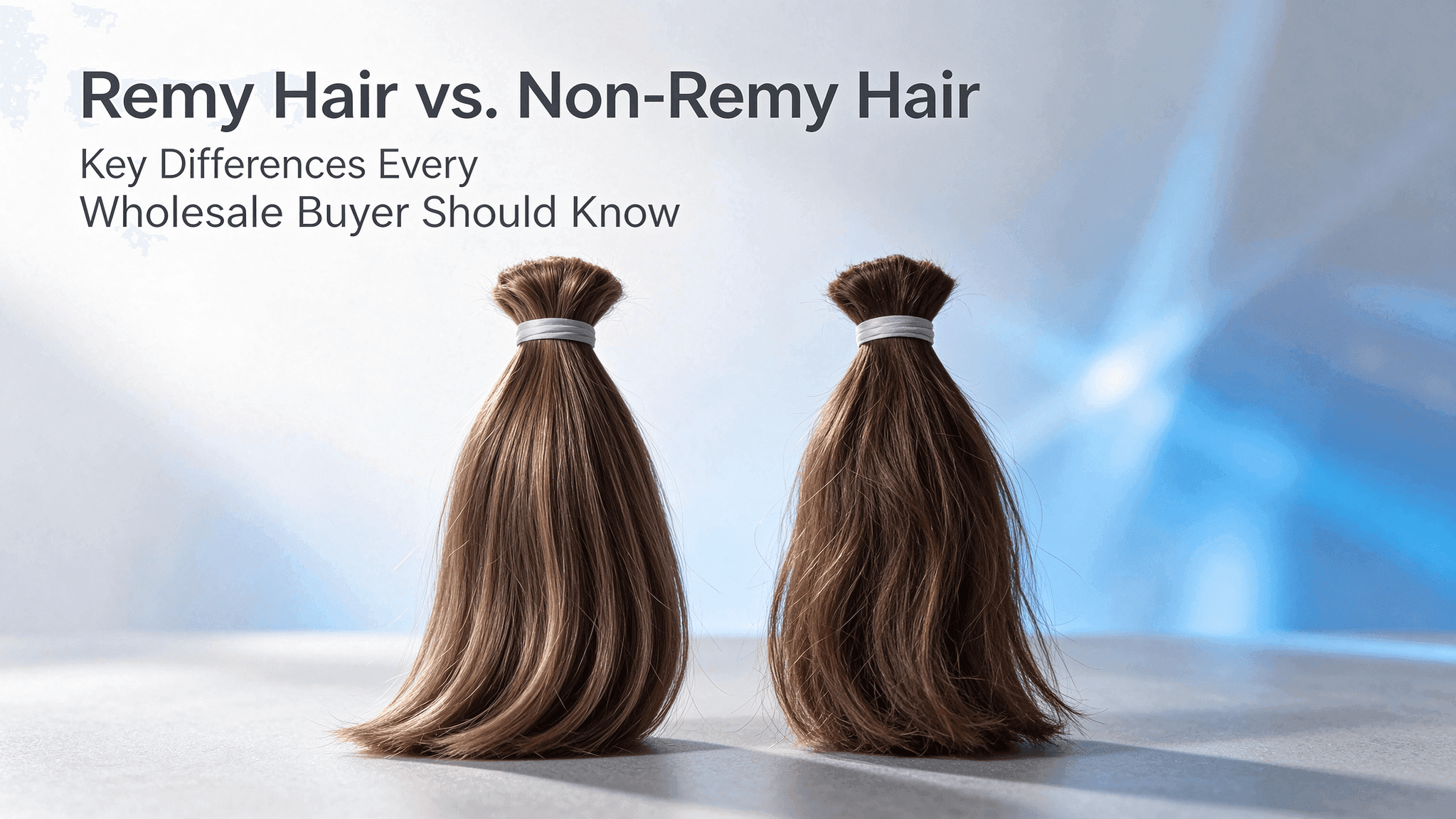
Remy Hair vs. Non-Remy Hair: Key Differences Every Wholesale Buyer Should Know
Remy hair and non-Remy hair are two commonly used categories in the human hair industry. Although both can be used to manufacture wigs, extensions, and hairpieces, they differ in cuticle alignment, processing methods, texture consistency, and maintenance requirements. Understanding these differences helps wholesale buyers evaluate raw materials, compare product specifications, and make more informed purchasing decisions.
Human hair is one of the most important raw materials used in the wig and hair extension industry. However, not all human hair products have the same structure, processing history, or performance.
Two commonly used terms in the industry are Remy hair and non-Remy hair. These terms are often mentioned in product specifications, supplier descriptions, and wholesale quotations. For buyers, understanding what they actually mean is essential when evaluating hair quality and comparing products from different manufacturers.
This guide explains the differences between Remy and non-Remy hair, including cuticle alignment, processing methods, product characteristics, and key purchasing considerations.
1. What Is Remy Hair?
Remy hair generally refers to human hair collected and processed with the cuticles aligned in the same direction, from root to tip.
The cuticle is the outermost protective layer of a human hair strand. It consists of overlapping scale-like structures that naturally point toward the hair ends.
When the cuticles remain aligned in the same direction, individual hair strands are less likely to rub against each other in opposing directions. This helps reduce friction and can contribute to smoother hair movement and easier detangling.
Remy hair is commonly used in premium human hair wigs, hair extensions, toppers, and other hairpieces.
However, the term Remy does not automatically guarantee that a product is completely unprocessed, chemically untreated, or of a particular grade. Processing methods and overall quality can vary between manufacturers.
2. What Is Non-Remy Hair?
Non-Remy hair refers to human hair in which the cuticles are not consistently aligned in the same direction.
During collection, hair from different sources may be mixed together without maintaining the original root-to-tip orientation. As a result, some strands may face opposite directions.
When cuticles are misaligned, they can catch against one another, increasing friction between strands. This may lead to tangling, especially during washing, brushing, and repeated use.
To improve the appearance and manageability of non-Remy hair, manufacturers may use various processing techniques, such as cleaning, conditioning, coating, or chemical treatments.
The exact process depends on the manufacturer and product specifications.
Non-Remy hair is used in different types of human hair products, particularly where price and product positioning are important considerations.
3. Key Differences Between Remy Hair and Non-Remy Hair
Although both types are made from human hair, their structural characteristics and processing requirements can differ.
3.1 Cuticle Alignment
The most important difference is the direction of the hair cuticles.
Remy hair: The cuticles are generally aligned in the same direction, from root to tip.
Non-Remy hair: The cuticles may face different directions because the original hair orientation has not been consistently maintained.
Cuticle alignment influences how hair strands interact with one another and is an important factor when evaluating raw human hair.
3.2 Texture and Smoothness
Remy hair generally offers a smoother feel because aligned cuticles reduce friction between individual strands.
Non-Remy hair may require additional processing to improve its surface feel and manageability. Depending on the treatment, the hair may initially feel smooth, but its performance can change after repeated washing.
It is important to remember that smoothness alone cannot confirm whether hair is Remy or non-Remy.
3.3 Tangling and Maintenance
Cuticle alignment can influence the likelihood of tangling.
Remy hair generally has a lower tendency to tangle because the cuticles follow the same direction. Proper care is still necessary, as tangling can also result from dryness, processing damage, hair density, and product construction.
Non-Remy hair may be more prone to tangling because misaligned cuticles can catch against each other.
For buyers, maintenance requirements should be considered alongside the intended retail price and target customer expectations.
3.4 Processing Methods
Remy hair and non-Remy hair may undergo different processing methods depending on their initial condition and intended use.
Remy hair may be cleaned, sorted, colored, or otherwise treated while maintaining cuticle alignment, depending on the product requirements.
Non-Remy hair may require additional processing to improve texture and reduce tangling. Some products may use surface coatings or conditioning treatments to create a smoother initial feel.
Therefore, buyers should not assume that all Remy hair is unprocessed or that all non-Remy hair uses the same treatment process.
3.5 Price and Product Positioning
Remy hair is often positioned in higher-value product categories because maintaining cuticle alignment requires careful collection, sorting, and handling.
Non-Remy hair can offer manufacturers greater flexibility in raw material sourcing and product positioning.
However, actual prices depend on multiple factors, including hair origin, length, color, texture, processing, availability, and order specifications.
The terms Remy and non-Remy should not be used as the only basis for comparing quotations.
4. How to Evaluate Remy Hair Quality
For wholesalers, importers, and brand buyers, checking the actual product is more important than relying entirely on product descriptions.
The following factors can help buyers evaluate human hair quality.
4.1 Check Hair Texture
Observe whether the hair feels reasonably smooth and consistent throughout its length.
Check for excessive dryness, rough sections, or noticeable differences in texture between strands.
4.2 Observe Tangling
Gently comb the hair from the ends upward and observe whether excessive tangling occurs.
The evaluation should be carried out under consistent conditions, as hair length, texture, density, and processing can all affect tangling.
4.3 Check Hair Shedding
Observe whether excessive shedding occurs during gentle brushing and handling.
Some shedding may occur in hair products, but unusually high shedding may indicate problems with hair attachment, knotting, or manufacturing quality.
4.4 Understand Processing History
Ask the manufacturer whether the hair has been colored, bleached, chemically treated, or coated.
Processing history can influence hair strength, texture, color stability, and maintenance requirements.
4.5 Request Consistent Samples
For bulk purchasing, buyers should request samples that represent the specifications of the intended order.
It is also important to confirm whether the sample and bulk production will use the same raw material category, processing methods, and quality requirements.
5. Common Misunderstandings About Remy Hair
Several misconceptions are common in the human hair market. Buyers should understand these distinctions before making purchasing decisions.
Misunderstanding 1: All Remy hair is completely unprocessed.
Not necessarily. Remy describes the alignment of the cuticles, not the absence of chemical processing. Remy hair may still undergo coloring, bleaching, or other treatments.
Misunderstanding 2: Non-Remy hair is always poor quality.
Not necessarily. Product quality depends on the raw material, processing methods, manufacturing techniques, and quality control. Non-Remy hair may be suitable for certain product categories and price ranges.
Misunderstanding 3: Smooth hair is always Remy hair.
A smooth surface does not prove cuticle alignment. Conditioning agents and surface coatings can temporarily improve the feel of hair.
Misunderstanding 4: Remy hair always lasts longer.
Cuticle alignment can contribute to easier maintenance, but product lifespan also depends on raw hair quality, chemical processing, construction, styling habits, and care routines.
6. Questions Wholesale Buyers Should Ask Suppliers
Before placing an order, buyers should clarify the following details with manufacturers:
- Is the product made from Remy or non-Remy human hair?
- Are the cuticles aligned in the same direction?
- Has the hair undergone coloring, bleaching, or other chemical treatments?
- Are any silicone coatings or surface treatments applied?
- What hair lengths, colors, and textures are available?
- What are the product specifications and acceptable quality variations?
- What is the minimum order quantity (MOQ)?
- Can the manufacturer provide samples before bulk production?
- Will bulk orders follow the same specifications as the approved samples?
- What maintenance instructions should be provided to end customers?
These questions help buyers establish clear expectations and reduce misunderstandings during the purchasing process.
7. Conclusion
Remy hair and non-Remy hair are two different categories of human hair materials, primarily distinguished by cuticle alignment.
Remy hair generally maintains a consistent root-to-tip cuticle direction, which can help reduce friction and tangling. Non-Remy hair may contain strands with different cuticle directions and may require additional processing to improve manageability.
For B2B buyers, understanding these differences is important when comparing product specifications, evaluating samples, and selecting suitable materials for different market segments.
However, cuticle alignment is only one aspect of hair quality. Hair origin, processing history, manufacturing methods, and quality control should also be considered before confirming a wholesale order.