
Natural Texture Wigs Explained: Yaki, Kinky Straight, Kinky Curly and Coily Textures
Natural texture wigs are gaining attention as more consumers look for hairstyles that resemble their natural hair patterns. From Yaki Straight and Kinky Straight to Kinky Curly and Coily textures, each category offers a different appearance, volume and styling experience. This guide explains the characteristics of common natural texture wig types, the factors that influence their appearance, and the key quality considerations wholesale buyers should understand when sourcing textured wigs.
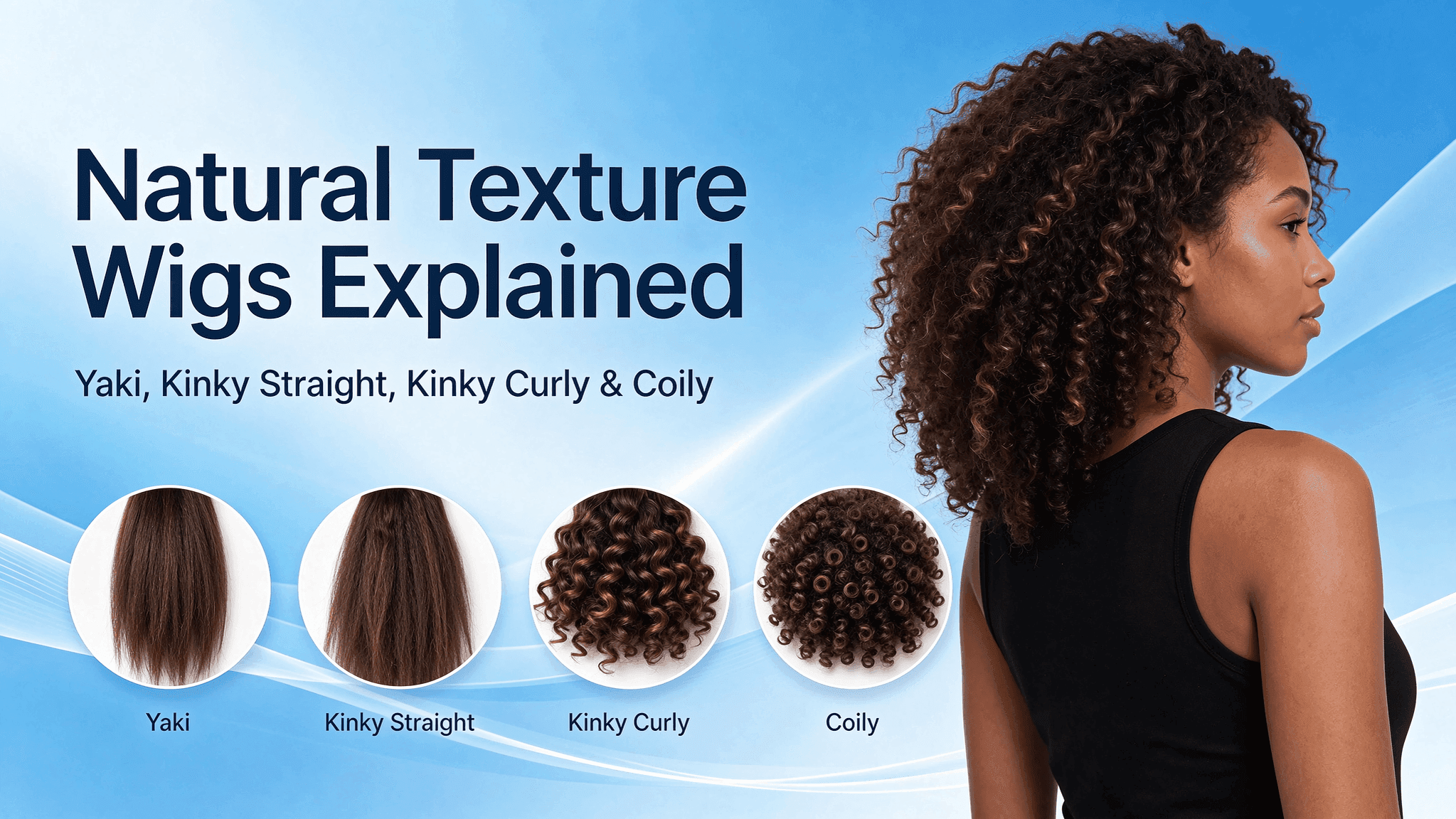
The wig market has traditionally offered a wide range of straight, wavy and curly styles. However, natural-looking textures are receiving increasing attention as consumers seek wigs that better resemble the appearance and movement of their own hair.
Recent 2026 wig trend coverage has highlighted textures such as Yaki, Kinky Straight, Kinky Curly and Coily as important product categories. These styles offer alternatives to highly smooth or uniform hair textures and provide more options for customers who prefer a natural-looking finish.
For wholesalers, importers and wig brands, understanding these texture categories is useful when developing product collections, comparing samples and communicating specifications with manufacturers.
1. What Are Natural Texture Wigs?
Natural texture wigs are designed to reproduce or resemble the appearance of naturally textured hair at different styling stages.
Depending on the product, the texture may resemble:
- Hair after a silk press or flat ironing.
- Hair after a blowout.
- Naturally stretched or loosely textured hair.
- Defined curls and coils.
- Tightly coiled natural hair.
These products can be made using human hair, synthetic fibers or blends, depending on the manufacturer's specifications.
It is important to understand that terms such as Yaki and Kinky Straight describe the finished texture or appearance. They do not identify the hair's country of origin, raw material or fiber composition.
For B2B buyers, confirming the actual material and texture specifications is therefore essential.
2. Common Types of Natural Texture Wigs
Natural texture wigs include several categories. Although manufacturers may use slightly different naming conventions, the following descriptions are commonly encountered in product catalogs.
2.1 Yaki Straight Wigs
Yaki Straight is a straight hairstyle with a subtle textured surface.
It is commonly designed to resemble hair that has been relaxed, pressed or straightened while retaining some natural-looking texture.
Typical characteristics include:
- A mostly straight appearance.
- Slightly textured rather than completely smooth strands.
- Moderate visual volume.
- A less glossy finish than some silky straight styles.
Yaki Straight may be suitable for customers who want a polished straight hairstyle without the extremely smooth appearance of bone-straight hair.
The exact degree of texture varies by manufacturer, so product samples are useful when comparing different Yaki options.
2.2 Kinky Straight Wigs
Kinky Straight is designed to resemble naturally textured hair after a blowout.
Compared with Yaki Straight, it generally has more visible texture and a fuller appearance.
Common characteristics include:
- A straight overall silhouette.
- More pronounced surface texture.
- Greater visual body and volume.
- A finish that resembles stretched natural hair.
This texture can be suitable for customers who prefer a fuller straight hairstyle rather than a completely sleek finish.
The difference between Yaki and Kinky Straight is not always defined consistently across manufacturers. Buyers should compare actual samples instead of relying entirely on product names.
2.3 Kinky Curly Wigs
Kinky Curly wigs feature tighter, more defined curls and a textured appearance.
Depending on the product design, the curls may be compact, spring-like or irregularly arranged to resemble naturally curly hair.
Typical characteristics include:
- Defined curl patterns.
- Noticeable volume.
- A textured appearance from root to ends.
- Greater sensitivity to changes in moisture and handling compared with smoother straight styles.
Kinky Curly wigs may be selected by customers who prefer visible curl definition and a fuller natural-hair-inspired look.
The exact curl pattern and degree of shrinkage depend on the fiber or hair material, curl formation and manufacturing process.
2.4 Coily and Afro-Textured Wigs
Coily and Afro-textured wigs are designed to reproduce tighter natural hair patterns.
Depending on the product, the texture may feature small coils, dense curls or a fuller, rounded silhouette.
Common characteristics include:
- Tightly formed coils or curls.
- A visibly textured surface.
- Significant visual volume.
- A distinctive natural-hair-inspired shape.
Some products are designed to resemble a stretched Afro texture, while others retain a more defined coil pattern.
Buyers should request close-up photographs and physical samples because the term Afro-textured can cover a wide range of appearances.
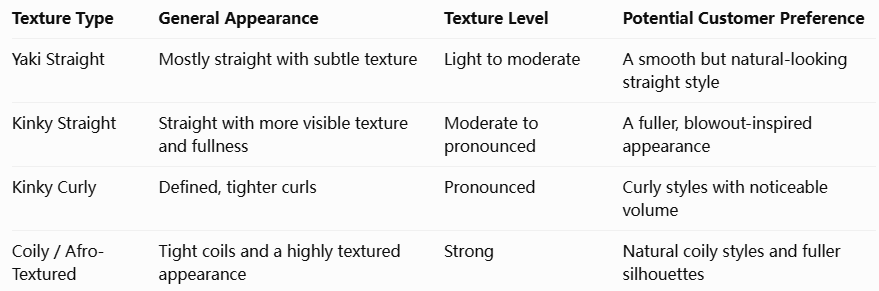
3. Comparing Common Natural Texture Wig Types
The following comparison provides a general reference for selecting different texture categories. Actual appearance may vary depending on the manufacturer, material and production process.
4. What Factors Influence the Appearance of Natural Texture Wigs?
The texture name alone does not determine how the finished wig will look. Several other factors can influence the result.
4.1 Hair or Fiber Material
Human hair, synthetic fibers and blended materials can produce different results.
Human hair wigs may offer more options for heat styling and restyling, depending on the hair's processing history and the manufacturer's care instructions.
Synthetic wigs are produced using manufactured fibers. Their heat resistance and styling flexibility depend on the specific fiber type and product design.
Buyers should never assume that every natural texture wig is made from human hair. The material composition should be confirmed separately.
4.2 Texture Formation Process
Natural-looking textures can be created or modified through different manufacturing methods.
Depending on the material and product, the process may involve mechanical styling, heat treatment or other texture-forming techniques.
The specific method varies between manufacturers and materials.
For this reason, buyers should ask how the texture is created and whether it is expected to remain consistent after washing and normal use.
4.3 Curl Pattern and Definition
For curly and coily wigs, curl definition is an important quality consideration.
A well-presented sample should have a reasonably consistent pattern throughout the product, although some natural variation may occur.
Buyers should check whether:
- The curls are distributed consistently.
- Some sections appear significantly looser than others.
- The ends maintain a suitable curl pattern.
- The texture remains recognizable after washing.
4.4 Hair Distribution and Product Shape
The distribution of hair affects how a textured wig looks when worn.
For example, tightly curled textures may create considerable visual volume even when the individual strands are not especially thick.
A balanced product design should consider the relationship between texture, hair distribution, cap construction and overall silhouette.
4.5 Length Measurement and Shrinkage
Curly and coily textures may appear shorter than their stretched length because of the natural contraction of the curl pattern.
This is commonly described as shrinkage.
For B2B orders, buyers should clarify whether the listed length is measured with the hair stretched or in its natural curl state.
The measurement method should be agreed upon before production to avoid misunderstandings about finished product length.
5. How Should Wholesale Buyers Evaluate Natural Texture Wigs?
When sourcing textured wigs, wholesale buyers should evaluate both the appearance and the performance of the texture.
5.1 Request Close-Up Texture Photographs
Full-length product photographs may not reveal the actual texture clearly. Ask for close-up images of the roots, middle sections and ends.
5.2 Compare Physical Samples
Whenever possible, compare samples from different manufacturers. Product names alone are not sufficient for judging texture quality.
5.3 Check Texture Consistency
Examine whether the texture is reasonably consistent throughout the wig. Look for unexpected changes in curl size, straightness or surface appearance.
5.4 Evaluate Washing Performance
For products intended to be washed and reused, check whether the texture returns to the expected appearance after washing and drying according to the manufacturer's care instructions.
5.5 Inspect Hair Ends
Pay particular attention to the ends of longer textured wigs. Check for excessive thinning, uneven curl formation or an appearance that differs significantly from the middle sections.
5.6 Confirm Heat Styling Instructions
If the product is made from human hair or heat-friendly synthetic fibers, ask the manufacturer for appropriate styling guidance.
Do not assume that every synthetic fiber can withstand the same temperature or that every processed human hair product will respond identically to heat.
5.7 Check Batch Consistency
For repeat orders, confirm that the manufacturer can maintain comparable texture patterns, materials and product specifications across production batches.
6. Questions to Ask Manufacturers Before Bulk Ordering
Before purchasing natural texture wigs in bulk, buyers should clarify the following details:
- Is the product made from human hair, synthetic fibers or a blend?
- How is the texture created?
- What does the manufacturer mean by Yaki, Kinky Straight or Kinky Curly?
- Is the texture expected to remain after washing?
- How is the finished length measured?
- Are different curl patterns or texture levels available?
- Can the manufacturer provide close-up photographs and physical samples?
- What care and heat styling instructions should be followed?
- Can the same texture specifications be maintained for repeat orders?
For product development and long-term sourcing, keeping an approved sample is particularly useful. It provides a practical reference when evaluating future production batches.
7. Final Thoughts
Natural texture wigs provide a wide range of styling options, from subtly textured straight hair to tightly defined curls and coils.
Yaki Straight, Kinky Straight, Kinky Curly and Coily are useful product descriptions, but their exact appearance can vary between manufacturers.
For B2B buyers, the most reliable sourcing approach is to evaluate the actual texture, material composition, curl consistency, length measurement and maintenance requirements rather than relying only on product names.
By comparing samples and confirming detailed specifications, wholesalers and wig brands can develop more consistent product collections and select styles that better match their target customers.