
Human Hair Coloring and Bleaching in Wig Manufacturing: Processes, Risks and Quality Checks
Coloring and bleaching are important processes in human hair wig and extension manufacturing. They allow manufacturers to create different shades, from natural browns and blacks to lighter blondes and fashion colors. However, chemical processing can also affect the hair's cuticle, cortex, strength, and overall manageability. This guide explains common coloring methods, the difference between dyeing and bleaching, potential processing risks, and practical quality checks for wholesale buyers.
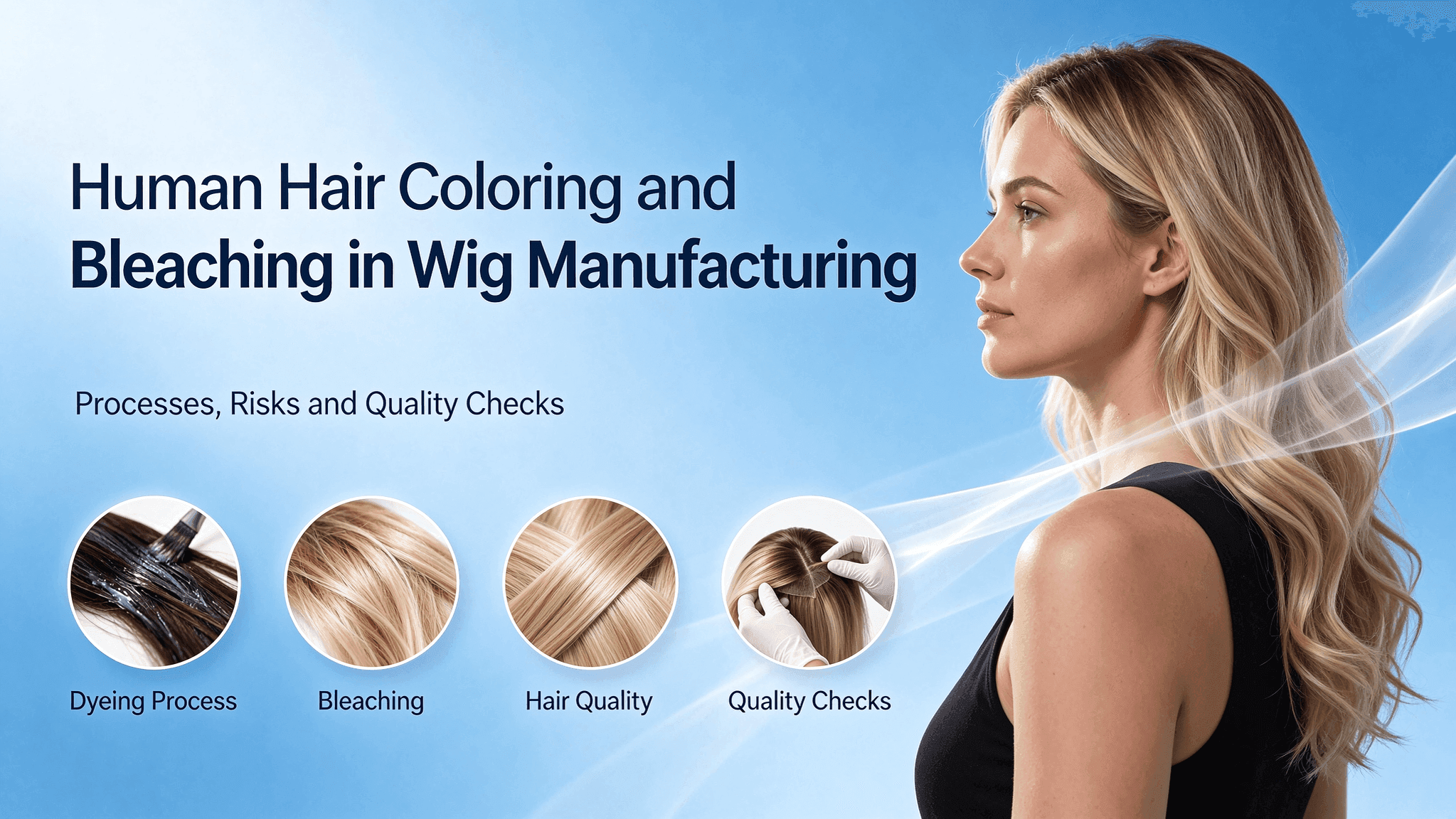
Color is one of the most noticeable features of wigs and hair extensions. Whether a product is designed in a natural black shade, a warm brown, a blonde tone, or a fashion color, its appearance depends partly on how the hair has been processed.
In human hair manufacturing, coloring and bleaching are used to modify the original pigment of the hair and achieve specific shades. These processes can create a wider product range, but they also introduce quality considerations that buyers should understand.
For wholesalers, importers, retailers, and private-label brands, evaluating colored human hair requires more than checking whether the finished shade looks correct. Buyers should also consider the hair's condition, color consistency, processing history, and performance after washing and styling.
1. Why Is Human Hair Colored in Wig Manufacturing?
Natural human hair is available in different shades, depending on its original pigmentation. However, manufacturers often need to adjust the color to meet specific product requirements.
Common reasons for coloring human hair include:
Producing consistent shades across a product range.
Creating blonde, brown, and other lighter colors.
Developing fashion shades and customized color combinations.
Matching customer specifications or reference samples.
Creating highlighted, rooted, ombré, or multi-tone effects.
Adjusting the appearance of hair used in wigs, toppers, and extensions.
For manufacturers, color processing makes it possible to offer more product variations. For buyers, it provides more options when developing collections for different customer groups.
However, the final result depends on the original hair color, previous processing history, material condition, and the coloring method used.
2. Hair Coloring vs. Hair Bleaching: What Is the Difference?
Hair coloring and hair bleaching are related processes, but they do not serve exactly the same purpose.
Hair coloring generally refers to changing or adding color to the hair. Depending on the formulation, color may be deposited mainly on the surface, penetrate partly into the hair, or develop through an oxidative chemical reaction.
Hair bleaching is primarily used to lighten the natural pigment in the hair. It works through oxidation, breaking down melanin pigments so that the hair becomes lighter.
Some permanent oxidative coloring systems combine pigment lightening and color development in the same process. The exact mechanism depends on the formulation and processing conditions.
Comparison | Hair Coloring | Hair Bleaching |
|---|---|---|
Main purpose | Add, change, or adjust hair color | Lighten the existing natural pigment |
Main target | Depends on the dye system and formulation | Primarily melanin pigments |
Typical result | Natural shades, fashion colors, and tone adjustments | Lighter underlying hair shades |
Processing | May involve pigment deposition or oxidative color development | Usually involves an oxidation-based lightening process |
Quality considerations | Shade accuracy, color consistency, and color retention | Lightening uniformity, hair condition, and breakage risk |
The exact process varies according to the product formulation, original hair condition, and manufacturer's production method.
3. Common Types of Hair Coloring Methods
Hair color products can be classified according to how the color interacts with the hair fiber and how long the color generally lasts.
Temporary Hair Color
Temporary color products mainly deposit color on the outer surface of the hair.
They are generally used for short-term color effects and are more easily removed through washing than permanent oxidative colors.
For hair products, the actual performance depends on the color formulation, hair condition, and application method.
Semi-Permanent Hair Color
Semi-permanent color products generally use pre-formed color molecules rather than relying entirely on oxidative color development.
Depending on the formulation, color may attach to the cuticle or penetrate partly into the hair fiber.
The degree of color retention and fading varies by product and material condition.
Permanent Oxidative Hair Color
Permanent oxidative hair color uses color precursors that react with an oxidizing agent to develop larger colored molecules within the hair fiber.
This process can also involve lightening some of the natural pigment, depending on the formulation.
Because it involves chemical reactions within the hair fiber, the process can affect the cuticle and internal structure.
For wig manufacturers, the choice of coloring system depends on the target shade, starting material, production requirements, and desired product characteristics.
4. How Does Bleaching Affect Human Hair?
Human hair consists of several structural components. The cuticle forms the outer protective layer, while the cortex contains much of the hair's structural protein and natural pigment.
During bleaching, oxidizing chemicals act on melanin to reduce the hair's natural color. However, the chemical reaction can also affect other parts of the hair fiber.
Research examining bleached human hair has found that more intensive bleaching can cause damage to cuticle layers, changes in the cortex, and increased protein loss. The extent of damage is related to processing severity and conditions.
Potential effects include:
1. Cuticle Damage
The overlapping cuticle scales may become rough, lifted, separated, or damaged. This can affect the hair's surface feel and resistance to friction.
2. Increased Dryness
Changes to the hair's surface and internal structure can reduce its ability to maintain a smooth feel. The finished hair may become rougher or more difficult to manage.
3. Reduced Strength
Excessive chemical processing can weaken the hair fiber, increasing the risk of breakage during combing, washing, and styling.
4. Uneven Color Results
Differences in the original hair pigment, material condition, and processing history may cause uneven lightening or inconsistent final shades.
5. Changes in Hair Texture
Chemically processed hair may not retain exactly the same feel or movement as the original material. The extent of change depends on the hair and processing method.
Not every bleached product will show the same degree of damage. Buyers should evaluate the actual sample rather than assume that all light-colored hair has identical performance.
5. Common Color Effects in Wigs and Hair Extensions
Different color effects require different production and finishing approaches.
Color Style | Description | Buyer Considerations |
|---|---|---|
Natural Black | A dark shade designed to resemble natural black hair | Confirm the exact shade rather than relying only on the color name |
Natural Brown | Brown shades with different warmth and depth | Check undertones and consistency |
Blonde | Light shades created through lightening and/or coloring | Inspect lightening uniformity and hair condition |
Highlighted | Selected sections have lighter or contrasting shades | Check placement, blending, and consistency |
Ombre | A gradual transition between two or more shades | Check the transition and color distribution |
Balayage | A blended, graduated color effect created through selective placement | Confirm the intended pattern and finished appearance |
Rooted Color | Darker roots combined with lighter lengths | Check root depth, transition, and consistency |
Color names are not always standardized across manufacturers. A shade described as ash brown, chocolate brown, or natural black by one supplier may differ from another supplier's version.
For wholesale orders, physical color swatches or approved reference samples are more reliable than color names alone.
6. Quality Risks Buyers Should Watch For
When sourcing colored human hair, buyers should pay attention to several possible quality problems.
Uneven Color Distribution
The hair may show different shades between sections, bundles, or lengths. This can be especially noticeable in blonde and other lighter colors.
Excessive Dryness
Hair may feel rough or difficult to comb after chemical processing. This can affect the finished product's appearance and customer experience.
Breakage and Weak Ends
Overprocessed hair may become more fragile, especially toward the ends. Buyers should inspect whether the hair breaks easily during gentle handling.
Color Fading or Transfer
Some color systems may release color during washing or repeated use. The degree of fading depends on the dye system, material, and care conditions.
Difference Between Sample and Bulk Production
A sample may look consistent while the bulk order shows variation in shade, texture, or processing condition. This is why approved reference samples and written specifications are important.
7. How Wholesale Buyers Can Inspect Colored Human Hair
A structured inspection process helps buyers evaluate both color appearance and material condition.
Step 1: Confirm the Color Reference
Before production, agree on a physical color swatch or approved sample.
Record:
Color reference or sample identification.
Main shade and undertone.
Whether the color is solid, highlighted, ombré, or rooted.
Which sections of the hair should have different shades.
Acceptable variation between production batches.
Do not rely on descriptions such as "light brown" or "ash blonde" without a visual reference.
Step 2: Inspect Color Uniformity
Examine the hair under consistent lighting.
Check:
Whether the shade is consistent from root to tip.
Whether different bundles have matching tones.
Whether highlighted sections are placed correctly.
Whether the transition between colors looks natural when required.
Whether any unexpected patches or discoloration are visible.
Step 3: Evaluate Hair Condition
Color accuracy is only one part of product quality.
Check the hair for:
Rough or damaged surface texture.
Excessive dryness.
Tangling during gentle combing.
Breakage during normal handling.
Uneven or fragile ends.
Differences between the sample and the approved specification.
Step 4: Conduct an Agreed Washing Test
If washing performance is important to the buyer, establish a test procedure before sample approval.
Agree on the washing method, water temperature, products used, and number of wash cycles.
Observe:
Whether the color fades noticeably.
Whether color transfers to the water or other materials.
Whether the hair becomes rougher after washing.
Whether tangling or breakage increases.
These are buyer-defined quality checks rather than a universal industry test. Results should be evaluated against the agreed product requirements.
Step 5: Compare Bulk Production with the Approved Sample
Retain the approved sample as a production reference.
When the order is delivered, compare:
Color shade and undertone.
Color distribution.
Hair texture and softness.
Length and weight.
Hair condition after handling.
Finished product construction.
Documenting the approved specifications helps reduce disputes and improves consistency in repeat orders.
8. Human Hair Coloring vs. Synthetic Hair Coloring
An important distinction in sourcing is that human hair and synthetic fibers do not respond to color processing in the same way.
Human hair contains natural melanin and has a cuticle-and-cortex structure. It can be processed using coloring and bleaching systems designed for human hair, although the results depend on its condition and previous treatments.
Synthetic fibers are manufactured materials with different chemical compositions. They cannot automatically be colored using the same methods as human hair.
For synthetic wigs and extensions, buyers should confirm whether the fiber is designed for a particular coloring method. Standard human-hair dye or bleach should not be assumed to work on synthetic materials.
When sourcing blended products, buyers should also confirm the material composition because human hair and synthetic fibers may respond differently to heat, washing, and color treatments.
9. A Special Note: Hair Bleaching vs. Bleached Knots
In the wig industry, the term "bleached knots" refers to a localized treatment intended to make knots on a lace base less visible.
It is different from bleaching the hair lengths to create a lighter hair color.
Buyers should distinguish between:
Hair bleaching: Lightening the pigment of the hair strands.
Bleached knots: Treating selected knots at the lace base to reduce their visibility.
These are separate product specifications. When ordering lace wigs, buyers should confirm whether bleached knots are included and evaluate the actual hairline and lace appearance on the sample.
Conclusion
Coloring and bleaching allow wig manufacturers to create a wide range of human hair products, but the final color is only one part of the quality equation.
For wholesale buyers, it is important to evaluate shade accuracy, color consistency, hair condition, processing history, and performance after washing. A product that matches the requested color but has poor hair condition may not meet the expectations of the final customer.
By confirming physical color references, testing samples under agreed conditions, and comparing bulk orders with approved specifications, importers, distributors, and brands can make more reliable sourcing decisions.