
Hair Weft Types Explained: Machine-Made vs. Hand-Tied Wefts
Hair wefts are widely used in hair extensions and wig manufacturing. However, different weft construction methods can affect thickness, flexibility, durability, and application. This guide explains the differences between machine-made and hand-tied hair wefts, their key characteristics, and what wholesale buyers should consider when sourcing weft products.
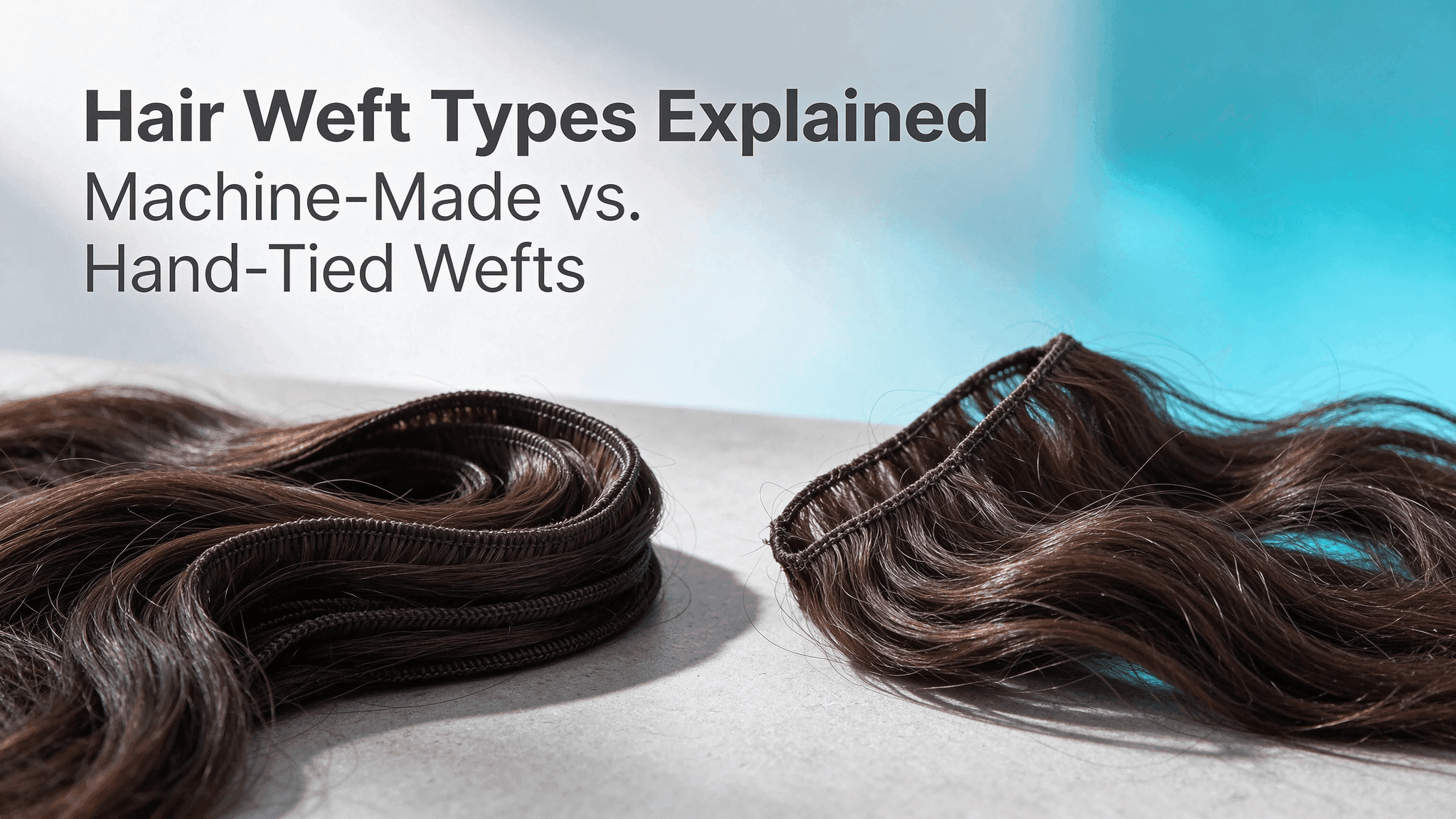
1. What Is a Hair Weft?
A hair weft is a section of hair strands secured together along a narrow base or track. It is commonly used to manufacture hair extensions, wigs, and other hair products.
Depending on the construction method, the hair strands may be secured using industrial sewing equipment or attached individually by hand.
Hair wefts are available in different widths, lengths, hair types, and construction styles. Their structure can influence how they are installed, how they move, and how they perform during everyday use.
For wholesalers and professional buyers, understanding weft construction is important when comparing products and selecting suitable options for different markets.
2. What Is a Machine-Made Hair Weft?
A machine-made hair weft is produced using specialized sewing equipment. Hair strands are arranged and secured along a stitched track, creating a continuous weft.
This construction method is widely used in hair extension production because it supports consistent manufacturing and is suitable for larger production orders.
Key Characteristics
- Consistent construction: Machine stitching helps create relatively uniform weft tracks.
- Production efficiency: The manufacturing process is suitable for larger production volumes.
- Structured base: The stitched track provides a defined attachment area.
- Various specifications: Machine-made wefts can be produced in different widths, lengths, and hair types.
Advantages
Machine-made wefts are commonly selected for their production efficiency and relatively stable construction. Depending on the materials and stitching quality, they can provide good durability for regular use.
They are also widely used in products where a continuous, sewn attachment track is required.
Points to Consider
The stitched base may be thicker than some hand-tied constructions. Depending on the design, this can affect how flat the weft sits against the head.
Buyers should evaluate the thickness, stitching quality, shedding, and overall flexibility of the finished product rather than relying on the manufacturing method alone.
3. What Is a Hand-Tied Hair Weft?
A hand-tied hair weft is made by manually securing individual hair strands or small groups of strands onto a fine supporting thread or base.
Compared with conventional machine-sewn wefts, hand-tied constructions are generally designed to create a thinner and more flexible attachment area.
This type of weft is commonly used in certain professional hair extension systems where a lightweight and relatively flat profile is preferred.
Key Characteristics
- Fine construction: The attachment area is generally thinner than a conventional machine-sewn track.
- Flexibility: The weft can follow the natural shape of the head more easily.
- Lightweight profile: The relatively fine base may help reduce bulk at the attachment area.
- Manual production: The manufacturing process requires skilled manual work.
Advantages
Hand-tied wefts are often chosen for their lightweight feel and flatter appearance.
Their flexible construction can help the weft sit closer to the head, which may be desirable for certain extension applications.
Points to Consider
Hand-tied wefts can require more labor and careful handling during production and installation.
Their fine construction may also make them more sensitive to pulling, cutting, or improper handling. Buyers should confirm the manufacturer's installation recommendations and care instructions.
Not all hand-tied products have identical structures. The actual thickness, flexibility, and durability depend on the materials and manufacturing techniques used.
4. Machine-Made vs. Hand-Tied Wefts: Key Differences
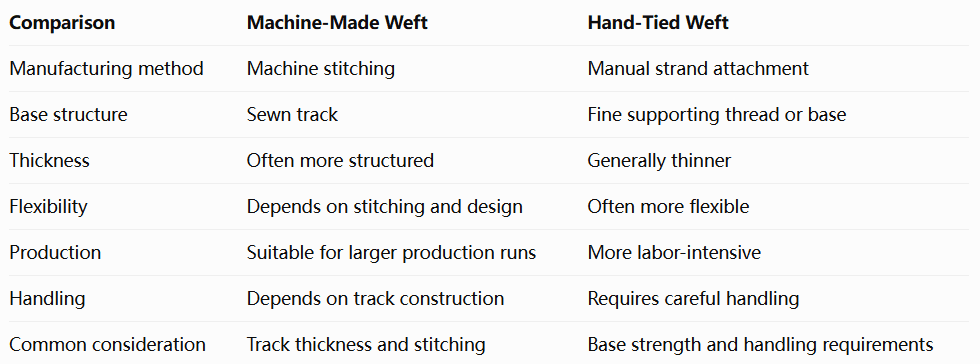
These are general characteristics rather than universal specifications. Different manufacturers may use different materials, construction methods, and quality-control procedures.
Therefore, buyers should compare actual samples rather than assuming that every product within the same category performs identically.
5. How Does Weft Construction Affect Hair Extension Performance?
The construction of a hair weft influences several aspects of the finished extension.
5.1 Thickness and Appearance
The thickness of the weft base affects how the extension sits against the head.
A thicker track may create more noticeable bulk in certain installation methods, while a finer construction may provide a flatter profile.
However, the overall appearance also depends on installation technique, hair density, and the number of wefts used.
5.2 Flexibility and Comfort
Flexible wefts can adapt more easily to curved areas of the head.
This may improve comfort in certain applications, although the final result also depends on attachment methods and individual wearing preferences.
5.3 Durability
Durability is influenced by the quality of the supporting base, stitching or attachment method, hair quality, and manufacturing consistency.
A machine-made weft is not automatically more durable than a hand-tied weft. Likewise, a thinner weft is not necessarily less durable.
Buyers should assess the finished product through physical inspection and practical testing.
5.4 Installation Requirements
Different weft constructions may require different installation techniques.
For example, certain hand-tied extension systems are designed to be installed without cutting through the delicate attachment area. Machine-made wefts may offer different cutting and attachment options depending on their construction.
Professional installation instructions should always be confirmed with the manufacturer.
6. What Should Wholesale Buyers Check When Evaluating Hair Wefts?
When sourcing hair wefts, buyers should evaluate both the hair itself and the construction of the weft base.
Important inspection points include:
1. Weft Thickness
Check whether the base thickness matches the intended product positioning and installation method.
2. Stitching or Attachment Quality
Inspect whether the hair is securely attached and whether the stitching or supporting thread is consistent.
3. Shedding
Gently examine the attachment area to identify excessive loose strands or signs of weak construction.
4. Hair Quality
Check hair texture, softness, tangling, and consistency throughout the weft.
5. Width and Length
Confirm that the actual dimensions match the agreed product specifications.
6. Flexibility
Evaluate how easily the weft follows the shape of the head without damaging or deforming the attachment area.
7. Color Consistency
For colored hair products, check whether the color is consistent across different sections and batches.
8. Sample-to-Bulk Consistency
Compare approved samples with bulk production to ensure that the construction, dimensions, and hair quality remain consistent.
7. What Information Should Buyers Confirm Before Placing an Order?
Before purchasing hair wefts in bulk, buyers should communicate the following specifications with the manufacturer:
- Hair type: Human hair or synthetic hair
- Hair length and color
- Hair texture and styling requirements
- Weft construction: Machine-made or hand-tied
- Weft width and base thickness
- Hair density and weight per piece
- Packaging requirements
- Sample approval requirements
- Production lead time and quality-control arrangements
It is also important to clarify whether the product is intended for sew-in extensions, professional extension systems, wig manufacturing, or another application.
Different applications may require different weft structures and specifications.
8. How to Choose the Right Weft for Different Applications
There is no single weft construction that is suitable for every product.
Machine-made wefts may be a practical option for buyers who prioritize production efficiency, consistent specifications, and a structured attachment track.
Hand-tied wefts may be more suitable for applications where a thinner profile and greater flexibility are important.
The right choice depends on several factors:
- Target customer preferences
- Installation method
- Desired thickness and flexibility
- Product price positioning
- Manufacturing requirements
- Expected product performance
For wholesalers and brands, testing samples under the intended installation conditions is one of the most practical ways to evaluate suitability.
Conclusion
Machine-made and hand-tied hair wefts are two common construction options used in hair extension and wig production.
Machine-made wefts are generally associated with efficient production and a structured stitched base, while hand-tied wefts are often preferred for their finer profile and flexibility.
However, neither construction method is automatically superior. Hair quality, attachment strength, manufacturing consistency, and intended application all influence the final product.
For professional buyers, understanding these differences makes it easier to compare suppliers, define product specifications, and select suitable wefts for different customer requirements.