
Global Wig Manufacturing Industry: Major Production Countries and Their Roles in the Supply Chain
The global wig industry relies on an international supply chain involving raw hair sourcing, synthetic fiber production, wig manufacturing and international distribution. China, Indonesia, Bangladesh and Vietnam are among the important countries in finished wig exports, while India plays a significant role in the human hair raw material supply chain. This article explores the major wig manufacturing regions, their industry characteristics and the factors international buyers should consider when choosing sourcing destinations.
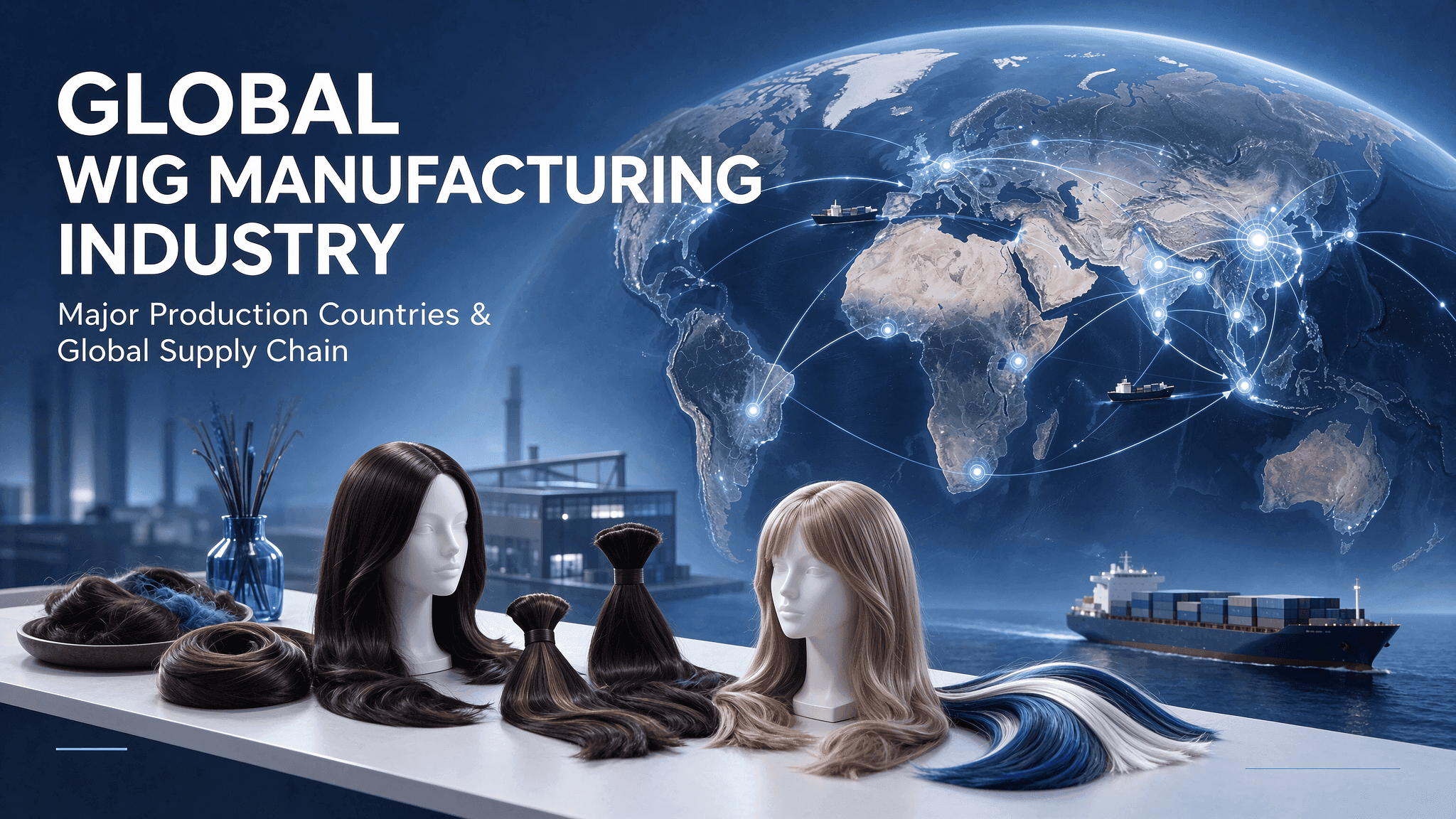
The global wig industry is not concentrated in a single country. Instead, it operates through an international supply chain connecting raw hair suppliers, synthetic fiber producers, wig manufacturers, wholesalers and retailers.
Different countries play different roles in this industry. Some specialize in processing human hair, while others focus on synthetic wigs, hairpieces, hair extensions or large-scale finished product manufacturing.
For international buyers, understanding this geographical distribution is important when evaluating suppliers, comparing production capabilities and developing a reliable sourcing strategy.
According to 2024 international trade data, China, Indonesia, North Korea, Bangladesh and Vietnam were among the leading exporters of wigs and hairpieces under HS 6704. However, export rankings should not be treated as an exact ranking of manufacturing capacity, because trade figures can also include re-exports and different product categories.
1. China: A Major Global Center for Wig Manufacturing
China is one of the most important countries in the global wig manufacturing industry, with a broad industrial base covering human hair wigs, synthetic wigs, toupees, hair toppers, hair extensions and related accessories.
The country's manufacturing capabilities extend across multiple stages of the supply chain, including hair processing, wig construction, coloring, styling, finishing and packaging.
One important characteristic of China's wig industry is its extensive product diversification. Manufacturers serve different market segments, from affordable synthetic wigs to customized human hair products and specialized hair replacement systems.
China also plays an important role in international raw material trade. A significant volume of human hair is imported for further processing and manufacturing.
According to 2024 trade data, China accounted for approximately 65.5% of global exports of wigs and hairpieces under HS 6704, making it the largest exporter in this product category.
Key industry characteristics:
Broad product categories and manufacturing capabilities
Established human hair processing and wig production supply chains
Large-scale production and customization capabilities
Extensive international trading connections
Manufacturers serving different quality and price segments
For international buyers, China is an important sourcing destination when looking for diverse product options and manufacturers with different production specializations.
2. India: An Important Source of Human Hair Raw Materials
India has a distinctive position in the global wig industry, particularly in the supply of human hair raw materials.
Human hair collected through temple donations and other channels enters a supply chain that includes collection, sorting, cleaning, processing and international distribution.
Indian hair is used by manufacturers in different countries to produce wigs, hair extensions, closures and other hair products.
India's importance should therefore be understood not only through finished wig exports, but also through its role as a raw material supplier.
Trade data for 2023–2024 reported that India exported approximately 5,311 tonnes of dressed or otherwise worked human hair, valued at around USD 573.95 million. China was its largest export destination by both value and volume.
Key industry characteristics:
Significant role in human hair collection and supply
Established sorting and processing activities
Different hair grades and characteristics
Important connections with international wig manufacturing markets
For buyers sourcing human hair products, it is important to distinguish between the origin of the raw hair and the country where the finished wig is manufactured.
A wig manufactured in China, for example, may contain human hair originally sourced from India or another country.
3. Indonesia: An Established Wig and Hair Products Exporter
Indonesia is another important country in the global wig and hair products trade.
Its manufacturing sector participates in the production and export of different hair products, including wigs and related articles.
The country is particularly relevant to buyers researching alternative manufacturing locations in Southeast Asia.
According to 2024 trade statistics, Indonesia ranked second among global exporters of wigs and hairpieces under HS 6704, with exports valued at approximately USD 304 million.
However, this figure covers a broad product category and does not mean that every Indonesian manufacturer specializes in the same type of wig.
Key industry characteristics:
Participation in international wig and hair products exports
Manufacturing activities across different hair product categories
Position within Southeast Asian production networks
Potential sourcing alternatives for international buyers
When evaluating Indonesian manufacturers, buyers should examine the actual product categories, material sourcing arrangements, production processes and export experience of each company.
4. Bangladesh: A Growing Participant in the Global Wig Supply Chain
Bangladesh has become an increasingly visible participant in international wig and hairpiece trade.
Its position in the global industry is connected to manufacturing and export activities across different hair product categories.
The country is also part of the wider South Asian and Southeast Asian sourcing network, where raw materials and semi-finished products can move between different countries before becoming finished consumer products.
In 2024, Bangladesh exported approximately USD 155 million in wigs and hairpieces under HS 6704, placing it among the leading exporting countries worldwide.
Key industry characteristics:
Participation in international wig and hairpiece exports
Manufacturing activities involving different product categories
Connections with regional raw material and production networks
An alternative sourcing destination worth evaluating
Buyers should not assume that every supplier in Bangladesh offers the same manufacturing capabilities. Product specialization, quality management and actual factory capacity need to be verified individually.
5. Vietnam: An Emerging Player in International Hair Products Trade
Vietnam is another country appearing in international wig and hairpiece export statistics.
Its participation in the industry is part of the broader development of manufacturing and export-oriented industries in Southeast Asia.
In 2024, Vietnam exported approximately USD 92 million in wigs and hairpieces under HS 6704, according to international trade data.
Vietnam is therefore worth considering when international buyers are researching regional sourcing alternatives.
However, the country's overall export value does not indicate that every manufacturer has extensive experience in high-end human hair wigs or specialized hair systems.
Key industry characteristics:
Participation in international hair products trade
Presence in Southeast Asian manufacturing networks
Opportunities to explore different production arrangements
Supplier capabilities that should be evaluated at the individual factory level
6. South Korea and Japan: Important Parts of the Synthetic Hair Industry
South Korea and Japan are also relevant to the global wig industry, particularly when examining the development of synthetic hair materials and related technologies.
Synthetic wigs rely on specialized man-made fibers, and the properties of these materials influence the final product's appearance, texture, heat resistance and styling possibilities.
Research into the global false hair product supply chain has identified China, Japan and Korea among countries involved in synthetic fiber production, while finished hair products are manufactured across China and several Asian production regions.
It is important to distinguish material production from finished wig manufacturing.
A country may have capabilities in synthetic fiber development or production without being one of the largest exporters of finished wigs.
Key industry characteristics:
Involvement in synthetic fiber and material technologies
Relevance to heat-resistant and specialty synthetic hair products
Contributions to the wider hair material supply chain
Importance of material specifications when evaluating suppliers
For buyers sourcing synthetic wigs, understanding the fiber type and its performance is often more useful than looking only at the manufacturing country.
7. Myanmar and Other Southeast Asian Countries: Regional Supply Chain Connections
Myanmar and other Southeast Asian countries also participate in the wider human hair and synthetic hair products supply chain.
Their roles can include raw material handling, hair processing, manufacturing and cross-border trade.
Academic research on the life cycle of false hair products has identified Myanmar, Indonesia, Bangladesh, Vietnam and Malaysia among the manufacturing regions involved in international hair product supply chains.
However, the scale and specialization of manufacturing differ significantly from one country to another.
International buyers should evaluate individual factories rather than assume that an entire country has a uniform production structure.
8. Global Wig Industry: Different Countries Play Different Roles
The international wig supply chain can be understood through four main stages.
Supply Chain Stage | Important Countries and Regions | Main Activities |
|---|---|---|
Human hair sourcing | India and other sourcing regions | Hair collection, sorting and raw material supply |
Synthetic fiber materials | China, Japan and South Korea | Synthetic fiber and material production |
Finished wig manufacturing | China, Indonesia, Bangladesh, Vietnam and other Asian regions | Wig construction, processing and finishing |
International distribution | North America, Europe, Africa and Asia | Importing, wholesale, retail and distribution |
These categories are not mutually exclusive. Some countries participate in multiple stages, while manufacturers may purchase materials from several international sources.
The global industry is therefore better understood as an interconnected supply chain rather than a collection of isolated national industries.
9. What Should International Buyers Consider When Choosing a Manufacturing Country?
Understanding the global production landscape is only the first step. Buyers also need to determine which sourcing location is suitable for their specific business requirements.
Several factors should be considered.
1. Product specialization
Different manufacturers may specialize in full wigs, lace front wigs, men's toupees, hair toppers, hair extensions or synthetic wigs.
Buyers should look for manufacturers with relevant experience in their target product category.
2. Raw material availability
Human hair products depend on material sourcing, while synthetic wigs depend on fiber specifications and material performance.
Buyers should ask about material origins, grades and consistency.
3. Manufacturing capabilities
The ability to produce a product does not automatically mean that a manufacturer can handle every customization requirement.
Check the actual production processes, equipment, skilled labor and quality-control procedures.
4. Quality consistency
For wholesalers and private-label brands, consistent quality across repeat orders is particularly important.
Buyers should confirm samples, document product specifications and establish inspection arrangements.
5. Export and logistics capabilities
International orders require appropriate packaging, export documentation and transportation arrangements.
A supplier's experience with the buyer's destination market can help simplify the process.
6. Total sourcing cost
Product price is only one part of the overall purchasing cost.
Raw materials, customization, transportation, import duties, taxes and other expenses should all be considered when comparing sourcing locations.
Conclusion: The Global Wig Industry Is Built on International Cooperation
The global wig manufacturing industry is supported by different countries with different industrial strengths.
China is a major center for finished wig manufacturing and exports. India plays an important role in human hair raw material supply. Indonesia, Bangladesh and Vietnam are also significant participants in international hair products trade, while Japan and South Korea contribute to the wider synthetic fiber and materials industry.
For international buyers, there is no single sourcing destination that is suitable for every product category.
The most effective sourcing strategy is to understand the entire supply chain, identify manufacturers with the right specialization and evaluate their actual capabilities.
By looking beyond country names and focusing on product expertise, material quality, manufacturing processes and export experience, buyers can make more informed decisions and build a more reliable global wig supply network.