
A Guide to Women's Hair Toppers: Base Types, Construction, and How to Choose
Women's hair toppers are designed to add volume to thinning areas and provide coverage for partial hair loss. Different types vary in base construction, coverage area, attachment methods, and hair materials. For wholesale buyers and distributors, understanding these differences is essential when selecting suitable hair toppers for different customer groups and market needs.
1. What Are Women's Hair Toppers?
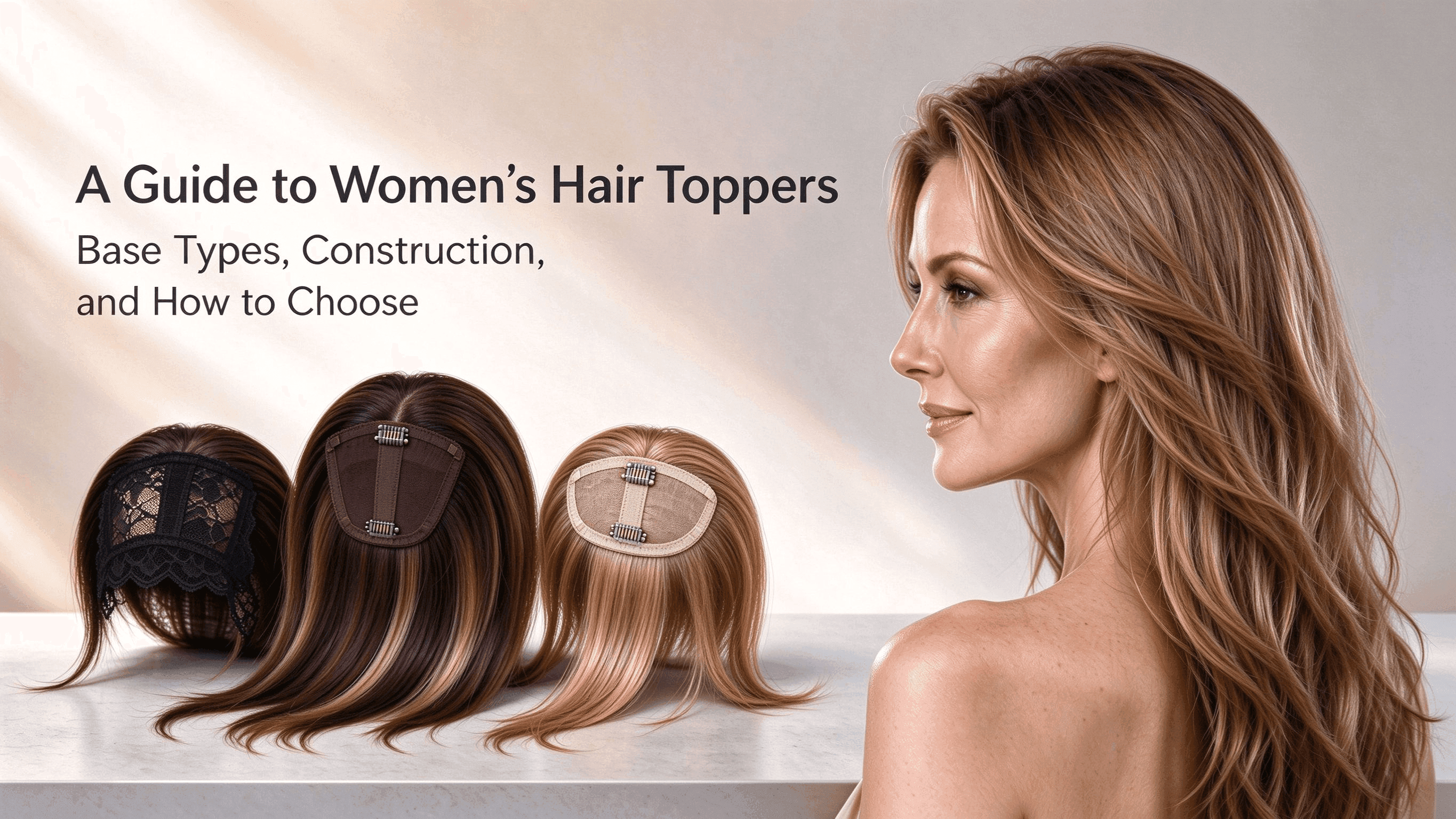
Women's hair toppers are partial hairpieces designed to add volume to specific areas of the scalp, particularly the crown, top of the head, and parting area. Unlike full wigs that cover the entire head, hair toppers cover only a selected section and are attached to the wearer's natural hair using clips, combs, or other attachment methods.
They are commonly used by people experiencing thinning hair, a widening part, or localized hair loss. Their appearance, comfort, and suitability vary depending on the coverage area and base construction.
For wholesale buyers, understanding the basic structure and functions of hair toppers is important when selecting products for different customer groups.
2. Common Hair Topper Base Constructions
The base is one of the most important components of a hair topper. Its construction affects the overall appearance, breathability, attachment method, and wearing experience. Different base designs serve different product requirements and customer preferences.
2.1 Lace Base
Lace base toppers use a lightweight mesh material as their foundation, with hair attached through hand-knotting or other manufacturing techniques.
This construction generally offers good breathability, and certain designs can create a natural-looking scalp appearance. The lace density, color, softness, and manufacturing technique all influence the final product.
Buyers should pay attention to lace durability, hair attachment quality, and the finishing of the base edges. These factors can affect both product appearance and service life.
2.2 Monofilament Base
Monofilament bases are typically made from fine, transparent-looking mesh materials. Hair is often individually knotted onto the base to create a realistic appearance.
One of their main advantages is the ability to create a natural-looking hair growth effect, particularly around the parting area.
Depending on the product design, monofilament material can be used across the entire base or in selected sections. Buyers should evaluate mesh softness, knot consistency, and the natural appearance of the parting area.
2.3 Silk Top Base
Silk top bases typically feature a multi-layer construction designed to conceal hair knots and create a more realistic scalp appearance.
They are commonly used in hair topper collections where a natural-looking crown is an important product requirement.
The number of layers, materials, and manufacturing methods can vary between manufacturers. Buyers should therefore evaluate the actual scalp appearance, base thickness, and wearing effect rather than relying on the product name alone.
2.4 Skin Base
Skin base toppers commonly use thin polyurethane (PU) or similar materials to create a scalp-like surface, with hair secured into the base structure.
Some skin base designs provide a smooth scalp appearance, while the edge construction influences how discreetly the topper blends with natural hair.
Important purchasing considerations include material thickness, flexibility, edge finishing, hair attachment strength, and wearing comfort.
3. Choosing Hair Toppers by Coverage Area
Besides base construction, coverage area is another important factor when selecting hair toppers. Customers have different levels and patterns of hair thinning, making the correct base size essential.
Common designs include:
- Small hair toppers: Suitable for mild thinning around the parting or crown.
- Medium hair toppers: Designed to add volume across a larger section of the top of the head.
- Large hair toppers: Suitable for customers who require broader coverage.
The actual dimensions and coverage areas vary by manufacturer and product design. Buyers should evaluate base length, width, coverage area, and clip placement to ensure the product meets different wearing requirements.
It is also important to consider how the topper blends with the customer's natural hair, including hair length, color, texture, and density.
4. Human Hair vs. Synthetic Hair Toppers
Hair toppers can be made from either human hair or synthetic fibers. These materials differ in appearance, styling flexibility, maintenance requirements, and product positioning.
4.1 Human Hair Toppers
Human hair toppers offer a natural texture and movement. Depending on the hair quality and processing methods, they can generally be styled with heat to varying degrees.
Key characteristics include:
- Natural-looking texture and movement.
- Greater styling flexibility, depending on the hair processing and product construction.
- Maintenance requirements similar to other human hair products.
- Suitability for customers who prioritize natural appearance and styling options.
Buyers should confirm the hair origin, processing methods, quality consistency, and recommended care instructions before purchasing.
4.2 Synthetic Hair Toppers
Synthetic hair toppers are made from manufactured fibers. Their appearance and performance depend on the type and quality of the fibers used.
Key characteristics include:
- Predefined styles that can retain their shape.
- Different heat-resistance levels depending on the fiber material.
- Maintenance requirements that differ from human hair products.
- Potential suitability for customers who prioritize price, style consistency, and everyday convenience.
Not all synthetic fibers are heat-resistant. Buyers should confirm the specific fiber type and manufacturer's heat-styling instructions before recommending any heat tools.
5. Key Quality Factors for B2B Hair Topper Buyers
For wholesalers, importers, and brand buyers, evaluating hair toppers requires more than checking the price and overall appearance. Several quality factors should be considered.
5.1 Hair Quality
Check whether the hair feels soft and smooth, and look for excessive tangling, dryness, or unusual shedding.
For human hair products, buyers should also understand the hair origin, processing methods, and maintenance requirements.
5.2 Base Construction
Inspect whether the base is flat and evenly finished. Look for visible damage, deformation, loose threads, or irregular edges.
The base should also be examined for consistency with the agreed product specifications.
5.3 Hair Attachment
Examine the consistency of knotting and hair distribution. Check whether noticeable shedding occurs during normal combing or gentle handling.
For hand-knotted products, the quality and consistency of knotting are particularly important.
5.4 Parting Appearance
Pay particular attention to the natural appearance of the parting area, knot visibility, and whether the base color creates the intended scalp effect.
This is especially important for products designed to simulate natural hair growth.
5.5 Color and Density
Check color consistency, density specifications, and whether the hair distribution looks natural.
For bulk orders, buyers should establish clear color references and density requirements to reduce differences between samples and production batches.
5.6 Attachment Method
Inspect clip placement, quantity, and fastening strength. Also evaluate how easily the topper blends with the wearer's natural hair.
The attachment system should be suitable for the intended product design and target customers.
6. Questions to Ask Before Purchasing Hair Toppers
Before confirming an order, buyers should clarify the following details with manufacturers to avoid misunderstandings about product specifications:
- Is the product made from human hair or synthetic fibers?
- What materials and construction methods are used for the base?
- What are the exact base dimensions?
- How are hair length, color, and density specified?
- Can the base size be customized?
- Can the number and placement of attachment clips be adjusted?
- Are different parting designs available?
- What is the minimum order quantity (MOQ)?
- What are the sample, production, and delivery lead times?
- Can bulk production maintain consistency with the approved sample?
Brand buyers may also need to confirm packaging, labeling, product instructions, and other customization requirements.
Clear product specifications help both buyers and manufacturers reduce communication errors and maintain consistency during production.
7. Conclusion
Choosing women's hair toppers involves several factors, including base construction, coverage area, hair material, manufacturing techniques, and attachment methods.
Lace, monofilament, silk top, and skin bases each have distinct construction characteristics and serve different product designs and customer requirements. Human hair and synthetic hair also offer different styling options and maintenance needs.
For B2B buyers, understanding these fundamentals helps define purchasing specifications, evaluate product samples, and communicate more effectively with manufacturers.
Before placing bulk orders, buyers should assess samples based on their target market, customer preferences, and intended product positioning. A clear understanding of product construction and quality requirements can help support more informed purchasing decisions.